No apologies from me for another look back. This time to October and the Deshain Festival when most of Nepal is having their main holiday of the year, many overseas migrant workers have travelled home to be with their families. As the fuel crisis was making transport unpredictable we decided to walk up the valley and do part of the Annapurna Circuit trek. We thought that we would see how far we could go in half of our time off then turn and retrace our steps. If it is written prose that you like then this is not the blog for you. I have tried to edit and reduce but there are still quite a few photos, a compilation from us both. Take yourselves on our journey in the comfort of your home with a pre-Christmas mince pie, cuppa, or stronger!
Day 1 - 16th October, Nadi Bazaar (890m) to Jagart (1300m)
We took a bus for the first little stretch from Besishahar, we know this area well, but started to walk at 10.30am. From Nadi Bazaar there are no buses but some intrepid travelers go by jeep but personally we felt safer on foot. The track in places is very narrow and potentially dangerous. A week later 5 people were to die further down the valley as their jeep went over the edge and plunged to the river below.
 |
| A sign of Deshain, these goats were taking their last journey. Off to market. |
Most families will slaughter a goat or buffalo for their family reunion. Many of the goats come over the mountains from nearby Tibet.
 |
| The monsoon is over but still there's enough water to make an impressive splash. |
We walked for just over 5 hours on day 1. Still in the green surroundings but walking through a deep valley with the Marsyangdi Khola (river) below, which we followed to it's source. We stopped for the night in Jagart (1300m). It was very apparent that due to the April earthquake and the subsequent fuel crisis that there were far fewer visitors and we were very warmly welcomed along the trail.
Day 2 Jagart to Danaqyu (2200m)
 |
| These beautiful wild bee cones, hanging from a south facing rock face. The black areas are thick with bees, unclear at this distance. |
Amazing to think that the honey in these cones will be harvested by intrepid honey gathers who hang from ropes on the cliff face. I understand that these bees are very fierce and I doubt the men have much protection. The harvest however is a valuable cash crop.
We slowly moved up through the valley and were soon seeing the evidence that we were heading into a predominately Buddhist region.
 |
| One of the many Mani Walls and Prayer wheels that we passed. |
Mani Walls, made of carved stones, Prayer Wheels and flags are ever present. They mark the influence of Tibetan Buddhism. The Prayer Wheels are spun clockwise to activate the 1000's of prayers wrapped inside. The Sanskrit lettering is the Buddhist mantra "om mani padme hum", hail to the jewel of the lotus. We remembered to always walk to the left of these. Some of the walls are ornate, beautifully painted and shining. Some are more basic and in my view more earthy and attractive. They all looked very loved and cared for.
 |
| The beginning of the trek is green with amazing contrasts of colour. |
 |
| The prayer beads are passed through fingers and thumb while quietly chanting. |
Our second night was spent in Danaqyu (2200 metres) where our lovely Lama hostess told us that she had only had 4 visitors in the previous month. The area is now very dependent on tourism and the competition is great.
 |
| Chilly fingers after a stroll in the dusk. |
Day 3 Danaqyu to Dhukur Pokhari
The day started with a good climb through some beautiful woodland, the clear air and forest smells were wonderful. Lots of timber harvesting activity and also an impressive apple farm both of which Simon has referred to in a previous blog: "Once more Nepal's rural economy is propped up by Timber".
Buckwheat is common here which we both enjoyed in bread and a Thedo Set for supper ( a local version of dal bhaat). Delicious.
 |
| Timely buckwheat harvesting as the crop has matured at the same time as families return for Deshain. |
Spectacular views begin to open up as we leave the woodland. From here onward we are drawn to the extraordinary signs of glacial, wind, rain and ice erosion. I am not a geologist but my interest was mounting!
 |
| \Kangaru Himal (6981m) |
 |
| A glimpse of Gungang Himal's Chulu Peak (6584m) |
A long day today, about 8 hours 30 minutes but so stunning it seemed easy. A new vista around every corner. It was feeling a bit colder now at 3240 metres, especially as the sun went down.
 |
Further evidence of glacial activity is this huge bare basin. Beautiful.
Day 4 Dhukur Pokhari to Menang
|
 |
| The longest line of prayer wheels beautifully painted. |
 |
| This is the way to cover the miles. |
 |
| A hillside village with many Bhuddist flags flying. Flat roofs and small windows hint at the harsh weather conditions. |
 |
| So many Mani stones written in Sanskrit and finely carved. |
 |
| Hollyhocks at this altitude was quite a surprise. Well deserved lunch break. |
 |
| A panoramic shot - akin to the Wild West landscape. |
 |
| The Marsyangdi is getting smaller as we head towards it's source. |
 |
A great shot taken by Simon. I loved the yaks.
A shorter day, 8am to 3pm and we arrived in Menang. It had felt a bit like the Wild West today. All that was missing was the tumble weed. The weather continued to be perfect, blue skies, warm sun but it was getting colder at night. Now at 3540 metres.
Day 5 Menang rest day
All trekkers are advised to have a rest day here, or nearby to acclimatise to the altitude in preparation for the next few days climb. We were happy to oblige and it gave us time to decide whether we should return as planned. Anyone who knows us both won't be surprised that the speed with which we had got this far and the challenge that awaited ahead had already sold the idea of continuing and trying to go over the Thorung La Pass. Decision made and a rest day it was. Well nearly. First a climb up to get a better look at the views!
|
 |
| More beautiful hollyhocks in Menang. Such a contrast to the harsh landscape. |
 |
| Berberis in it's natural setting. Shame about the old lady! |
We climbed up above Menang to Chongkor View Point. The Gangpurna Glacier, Annapurna 3, Thrurong Peak and Purbung Himal were all very clear and close. We sat and enjoyed the sun at a grazing encampment. The goats, cows and ponies spend the summer up here, while the crops are growing below. Animals are corralled at night in these simple huts. We were lucky enough to spend some time chatting to a lovely family group who have a hut here but today were on their way to gather wood. We are so fortunate to have learnt enough Nepali to make these conversations so special and managed to gather quite an insight into the lives of the local population.
 |
| Enclosures used to house goats, cows and ponies on summer nights while herders go to their homes below. |
 |
| A quick selfie before our descent. |
 |
| Looking back at the views of Gangapurna (7454m) |
Back in Menang and the goats were being brought in from the surrounding land. They live all over the village and we were so impressed that as the herder walks them through they peel off to their own dwellings. Well, apart from a few headstrong billy goats who had other things on their minds and caused a bit of a commotion!
 |
| Organised chaos as the goats find their way home. |
 |
| Captivating. |
Day 6. Menang to Thorung Phedi (4450m)
 |
| Vendors are having a hard year. |
 |
| Closed tea rooms a sign of low visitor numbers. |
After a steep start and feeling a little breathless the walking got easier, a steady rise. A few downhills were welcome although it does seem a pity to waste the altitude after so much effort. Many people stop again at Yak Kharka but we were there in good time and had no signs of altitude sickness, so decided to kick on.
More ponies carrying goods, locals and a few tourists along the way.
 |
| Such fragile beauty in this harsh landscape. |
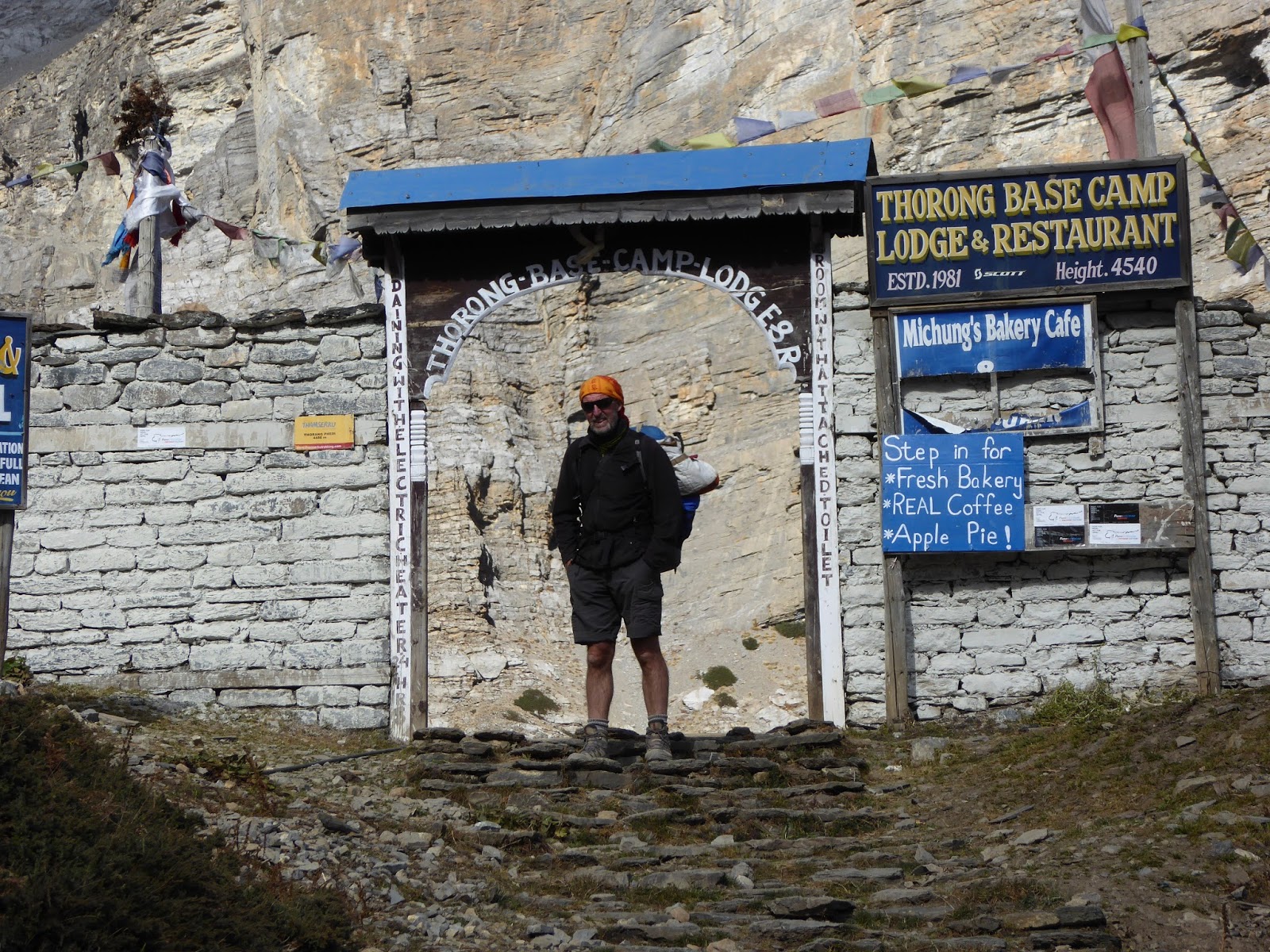
Again lots of geological interest, tectonic action as Simon explained, and wonderful strata. (Candice Marie of "Nuts in May" fame would have been impressed)! Walking across landslide scree was a bit unnerving but we arrived safely at Thorung Base Camp Lodge (still in good heart and healthy).
Day 7 Thorung Phedi to Muktinath
 |
| This pony hoped for a snack from a nose bag. |
These ponies are used to carry tourists up the final leg to the pass. The entrepreneurs sleep in tents at 4450 metres. Hardy men. Many trekkers leave here at 4 am to catch the sunrise at the top but we had a lie in until 6 am and fortified ourselves with some hot porridge. Sleep was difficult and minimal which is a normal side effect of high altitude but thankfully no sickness or headaches a sign of altitude sickness.
The blue sheep look well and very quiet. Apparently their horns keep growing until they are too heavy for the poor sheep to lift but as they are not culled to eat, as this is a Buddhist settlement, I think old age and a natural life span might also have something to do with their demise.
 |
| Tibetan Snow Cock at High Camp 4925m |
Walking got very tough now. No time for idle chat as every bit of energy and oxygen was needed to climb up. The walking conditions continued to be perfect but the path just kept going. Over every little summit there was another to struggle up.
 |
| "Are we nearly near yet" I kept asking myself! |
However it was good to look back at the magnificent view to the east.
 |
| Half a squashed Snickers bar renewed our strength at the top of Thorung La Pass. 5416 metres. |
So pleased to have got this far. For a couple of "oldens" we were very delighted and even a little proud of ourselves.
 |
| Going down was not as easy as it looked. Tough on those tired legs and knees. |
This was a completely different landscape, more like a moonscape, of the barren Kali Gandaki valley below. As we neared Mukninath the yellow vegetation was a welcome sight. It had been a tough day but well worth the effort and I felt very pleased that I had not let Simon down and that we had both been fortunate that we had not had any ill effects of altitude sickness.
At Muktinath we stayed at Bob Marley's Guest House, the only busy one that we had been to thus far. A bit of fun and an unusual find in the very special little town which is a pilgrimage site for Buddhist and Hindus alike. Every believer is meant to visit this holy place before they die, and also before their son make the pilgrimage.
 |
| The children have the lovely Tibetan features. |
 |
| And rosy cheeks! |
 |
| Souvenirs in abundance and not many tourists to buy. The colours are so bright in this hard landscape. |
Day 8 Muktinath to Marpha
 |
| Leaving Muktinath heading west towards Jharkot. |
This area is very barren apart from cultivated enclosures which have water irrigation from the surrounding hills. Apples and apricots are a special feature of the landscape and many are now dried for the tourist trade. Apple brandy, pies and jams are also a specialty.
 |
Quite a change in housing design.
The colours of the flags represent different elements: white, air; red, fire; green, water, yellow, earth and blue, space/ ether/ sky. |
 |
| Looking over the cob wall towards the north and Tibet. Upper Mustang is a very remote region. |
 |
| Caves in the rock where Muktinath's hermits have dwelt over many centuries.. |
 |
| Well loaded mules make their way towards Jomsom. |
 |
Simon spotted this avalanche on north face of Nilgiri (7061m). Quickly over.
|
 |
| A little girl picking up the mule dung. A vital ingredient to improve the hungry soil, and also a brning fuel. A heavy load for such a young person. |
 |
| Leaving Jomson behind but looking over the productive enclosures. |
 |
| The family at work threshing out the grain. |
 |
| Such a wonderful stile. |
 |
Father shows son the mule handlers skills. These are still a vital trade link to high altitude, remote settlements.
We arrived in the lovely village of Marpha. All of the walls are painted white which felt very welcoming after the less attractive feel of Jomsom. The last stretch had been a slog which is hardly a surprise as we had really pushed ourselves to get back to Lamjung in good time.
|
Day 9 Marpha to Ghorepani
 |
| Leaving Marpha |
 |
| Buffalo saddled and used as beasts of burden. |
It proved to be a testing day. We decided to do the road section to Tatopani by bus. which proved to be quite a challenge as the first one to come along would not let us get on. In Nepal buses have passengers on the roof and still the eager conductors want more trade. Patience finally paided off but then we had to wait for organised chaos at a changing point. No tickets, no information and lots of black market dealers lurking to make money! Simon managed to get 2 tickets for the first available bus and we were soon shoehorned in and on our way.
 |
| The Tibetan dress influence. |
Thankfully back on the number 11 bus, as Lamjung locals like to joke about their legs and walking, and we were again walking uphill towards Ghorepani and Poon Hill.
 |
| Such a lovely face. He used to live in the UK when with the Ghurkas, 1953 - 67. |
Day 10 Sikha to Ghorepani
Our penultimate day, shorter than most but hard on our tired legs. We were back in green vegetation and cropping similar to Lamjung. Ghorepani is a popular destination, close to the Poon Hill viewpoint. It was good to have a shorter day and it would be an early start on day 11.
Day 11 Ghorepani, Poon Hill and then Pokhara
An early start at 4 am and we climbed up to Poon Hill a well known vantage point. The view, as the sun rose, was memorable but sadly a little hazy. Not the highlight of our trip but worth the early start.
 |
| The sun rising over the Annapurna Mountain range |
 |
| As we walked back down towards Birethanti and the end of our trek we felt like these guys. A job well done!! |
A long downhill walk, mainly steps, reminded us of our Annapurna Base Camp Trek last Christmas. Hard on the knees but we were pleased to have managed the circuit. Reflecting, it is a pity that we did not have the time to do some of the side trips but we certainly have no regrets about the decision to go around. We were also lucky to have done this trek at such a difficult time for Nepal but the silver lining for us was the low numbers or trekkers and such warm and friendly welcomes from all of our hosts
Thank you again Nepal for giving us a memory that will stay with us for many years.
Thank you also if you have got this far.....
Wishing you all a very Merry Christmas and a Happy New Year.