|
A festive feel from this young monk as he plays with plumes of smoke at
Patan's Golden Temple. |
It’s a two way process being a VSO volunteer. I share a bit
and in return I learn a whole lot more. During those challenging times earlier
in the year, and many times since, Jude and I have sometimes nearly wept with
frustration. Yet when these feelings have subsided and we’re in a more rational
and reflective mood a realisation dawns that this has been, and continues
to be, an awesome trip. For example, working in the same team as volunteer
Jessica Stanford, who immediately after the earthquake changed her role from
bio gas engineer to join a team coordinating the disaster response in
Sindhupalchowk district, has been a humbling experience. Without complaint she
spent three months living under canvas working to ensure that international
relief efforts went to the right places and duplication was avoided. When the
time came to possibly jump back to her former placement she stayed on to
continue coordinating recovery in a district where rebuilding will take years.
 |
| Sindhupalchowk was badly damaged by the earthquake. |
 |
At last years Annual Volunteers Conference, Jessica is one of two people waving on the back row. The other is some old
bearded clown!!! |
In our communications with you through the blog and
during our brief summer visit back to the UK we were often faced with the question
‘how did we cope?’ Whilst trying to formulate an answer it is hard not to think
of our Country Director here at VSO Nepal who had only been in post for a few
months when the earthquake happened. Kim has had to struggle with all the challenges
of re-orientating program work to include earthquake responses and at the same
time set up systems that improve the safety of volunteers and staff. Work begun
before the disaster to restructure the country office has continued throughout
this time. There are no rehearsals for dealing with the fall-out of an
earthquake that has coincided with economic upheaval, but she has played her part
admirably. For us as volunteers being able to cope with the situation has been made much easier by her efforts.
 |
| Kim West, The Country Director, debriefing some ICS students, before they return home. |
Kim and Jessica are definitely two of my VSO Champions, as we move into this Christmas month.
So many of the Nepali people that I’ve met over recent
months have been heroic in their actions and the way they continue to live out
their lives despite the hardships of the natural disaster and the following economic
uncertainty.
 |
| Earlier in the year Juju Man with his daughter outside their new tented home and devastated house in Bungamati. |
How is Juju Man Shrestha I wonder? We met back in June
when I was invited for some ‘khaaja’ (snacks) in the tent he was sharing with
15 of his family members. We had visited the pile of rubble that was once his
home and met other community members from Bungamati who were making their
village safe by knocking it down! Recently I’ve heard that Juju’s housing predicament
is unchanged. The pile of rubble is a little tidier but rebuilding has not yet
begun, and due to the magnitude of the task is unlikely to begin any time soon. In search of work he has moved away to a less damaged district, taking his wife and family.
 |
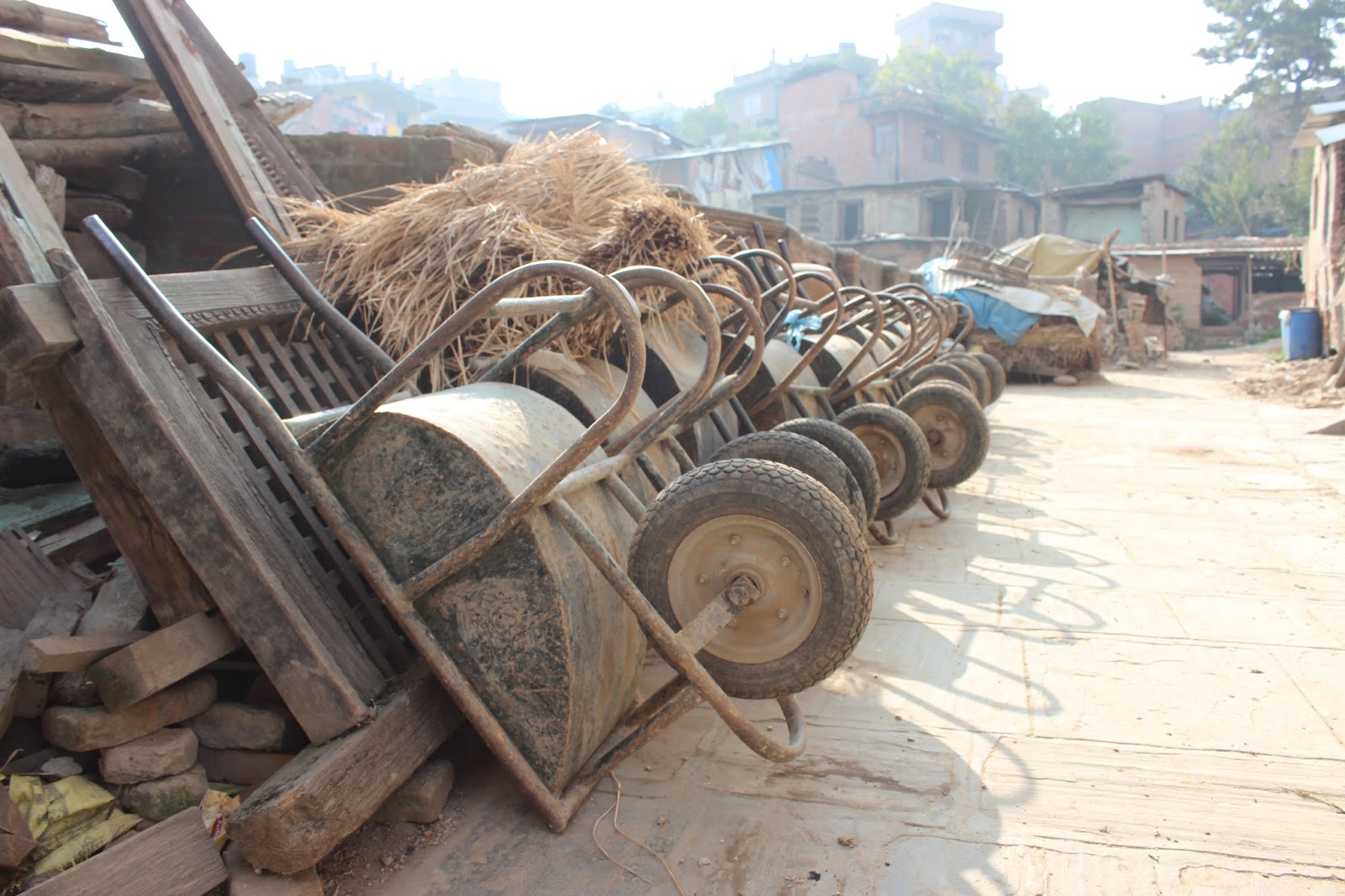
| Down time for the main mechanisation used to clear earthquake rubble. |
 |
These photo's taken in the last few days show how residents have dug the rubble away
from their homes to gain access and use the bottom floor. No attempt has been made
to rebuild the upper floors and roof. |
 |
Juju Man's house is now clear of rubble but there is no rebuilding anywhere in the village.
|
 |
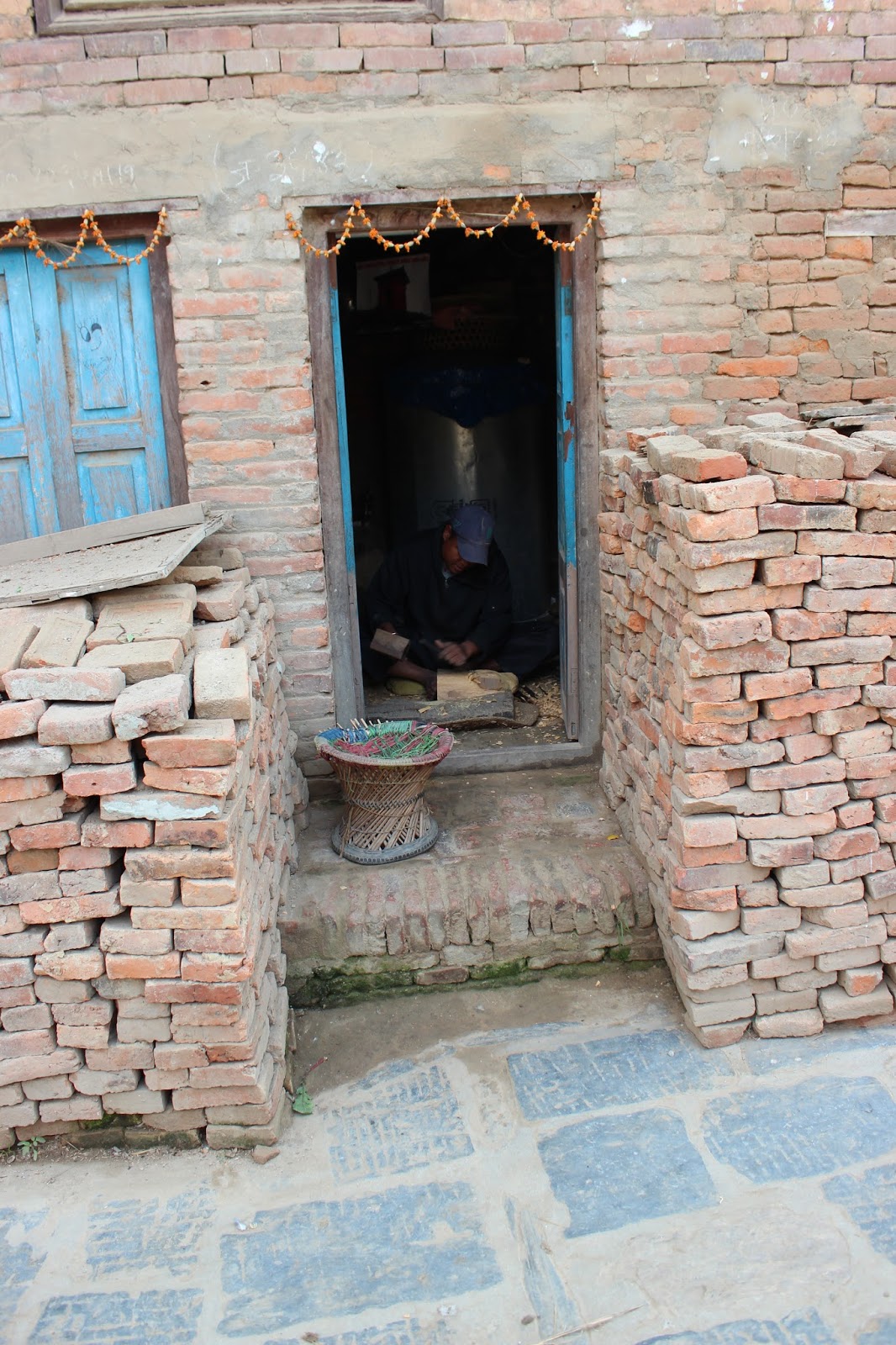
There are signs of recovery as some of the 300 Bungamati carving workshops damaged during the earthquake,
clear rubble, reclaim the bricks and resume crafting.
|
|
 |
| Juju Man's mother has moved in with family members. She waits patiently for a rebuilding program to begin. |
Back in January, on a field visit gathering information on
Nepal’s milk producers, I met farmers like Ram Prasad. They felt that after years of
turmoil the worst was behind them and there was now a predictable and sustained
demand for milk and dairy products. Since then the prospects of the 450,000 milk producers in
Nepal have certainly changed with the demand for milk crashing followed by the collapse of transport services as fuel supplies dried up. The headline now is that milk
production within the country has dropped by a staggering 50%. In remote areas
the dairy industry has been reduced to tatters. However, some milk supply
chains are looking to the time when things will return to normal, as they
surely will. There have been requests for help to improve raw milk and finished
product quality as the news of our work spreads through the value chain players. We
shall be supporting their efforts to plan and prepare for an uncertain future over coming months.
 |
| Milk producer Ram Prasad with his Bhainsi |
Tourism is one of the top three sources of national revenue
for Nepal. Uncertainty after the earthquake and difficulties of travel since
have all conspired to brutally dent this industry. It all makes a great headline
but how has it affected those in the community who depend on tourism for their
income? On a recent trek up to
Manang we met Shrijana Gurung . For the last twenty years she has run her small
hotel catering for those hardy individuals making their way around the
Annapurna Circuit. There are just three ways of getting to her isolated village
of Dhukur Pokhari, close to Upper Pisang in Manang district. A ten hour ride by
4x4, along the bone-crunching track which is carved into the sheer rock valley, by foot or pack mule train are the other alternatives. After two days of walking we found her hotel and were given the usual lovely warm welcome. We nibbled on locally produced apple flakes before tucking into a delicious daal bhaat cooked over a wood fire. As we chatted she
explained that there had been just four bookings during the past month and this
is her peak season!!
 |
| Goats are driven for several days to the low lying settlements, from the high Mustang Himal, to be sold for festive celebrations. |
 |
| Two jeeps meet on the precarious track, the only vehicular access to Manang district. |
 |
| Our Gurung landlady proudly displays her kitchen which, due to the lack of tourists, has been underused this year. |
More recently I have worked with smallholder pig farmers. Together
we are trying to develop a system of improved pig husbandry. This industry,
which was heralded as a real growth area, has also suffered from low demand and
transport difficulties during recent months.
What will the future hold for farmers like Kumari who was starting to move
away from simple subsistence enterprises by adding some cash generating options to her farming.
 |
| Stock woman Kumari proudly checking her animals, a scene repeated throughout the world. |
 |
Behind that simple image of livestock farmer there are always deeper stories of cultural
beliefs, market frustrations and future plans. |
These and people like them are all my champions. They seem
to have huge reserves of personal and community resilience, far beyond anything
I have previously experienced. They soldier on creating solutions to the most
intractable problems on an almost daily basis. Can’t get my products to market,
then just pop them on the bus. Nobody to take my pigs to slaughter……we’ll just
walk them there (anybody who has tried walking pigs anywhere knows how
difficult that task is).
 |
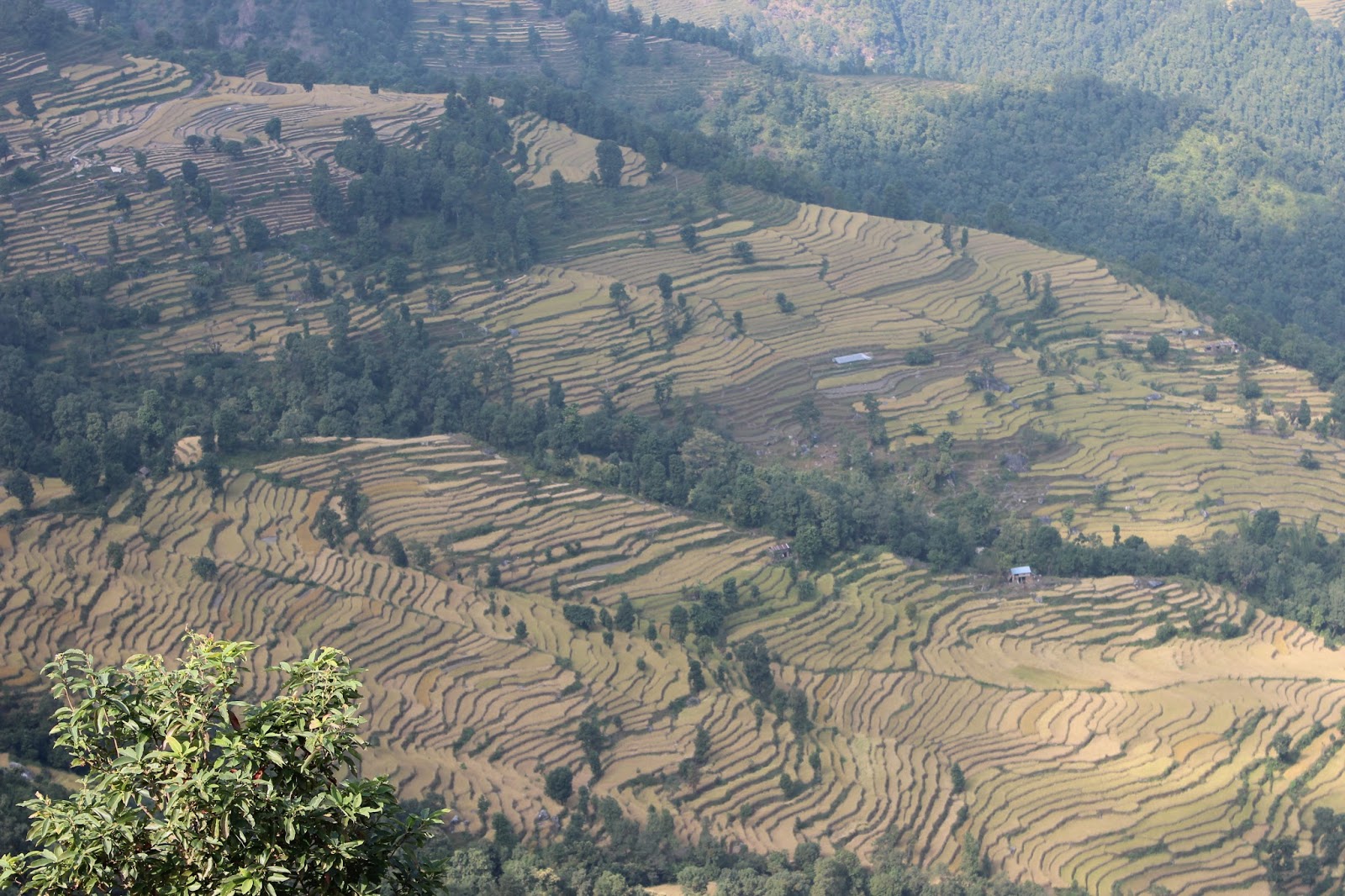
| The rice harvest that was jeopardised by lack of seed is finally drawing near to harvest. |
 |
| There is a role for everyone. The man hand cuts rice and swaths it for drying. |
 |
| These traditionally dressed Gurung farmers build a rick prior to thrashing. |
 |
| The finished rice rick with a traditional floral decoration. |
 |
| Thrashing complete straw is tied, using straw rope, and carried to the homestead for use as cattle feed. |
 |
| Carrying unthrashed rice from the paddy to a nearby rick. |
One of the first things I learnt when starting my placement
was to reduce my ‘expectations’ of what I could personally achieve. At the same
time I realised that even these now meagre outcomes would fail to materialise
unless a few colleagues, friends, development co-workers showed a little faith
and championed my cause. Needless to say I have been very privileged to work
alongside teams and individuals who have all created opportunities for me to
contribute to change. What more can I ask, it is then up to me to make the most
of these opportunities and push the wheel of sustainable change a very short
way along it's road.
 |
| Harihar works with a farmer focus group. |
 |
| Saurabh completes a questionnaire in Tanahan district |
 |
| Sijan with another farmer focus group in Sindupulchowk. |
“Samarth” is the name of the UK Aid funded project I work
with. This Nepali word means ‘making somebody able’ which also best describes
the aims of our work. Since joining the project back in February, Sijan my line
manager has helped me work in various teams. Building the capacity of people
requires those individuals to be open minded, receptive, and be confident
enough to get behind ‘change’. Sijan himself has all these qualities, and along
with Saurabh, a local consultant, did much of our initial program research that
has lead to the interventions on which we work. More recently I’ve worked
closely with Harihar, a food technologist who embraced our work fully and has been
a fantastic team member. It is difficult to measure the success of my
involvement. One personal measure of success is if my colleagues can present our work without me being present.
 |
| After data collation and report writing Harihar focuses his efforts on presenting findings to dairy industry stakeholders, which include government ministries, private industry and milk producing farmers. |
 |
| Saurabh presents our findings on behalf of farmers cooperatives to dairy industry stakeholders. This work has driven a range of interventions focused on improving market conditions and ultimately small holder farmer's incomes. |
All three of
these colleagues have successfully given quite complex technical presentations
to multi-stakeholder groups as part of our work. They have truly championed our
mutual cause.
 |
Taking timeout together we trekked around the Annapurna Circuit. Jude takes in the unbelievable
views of the Annapurna Himal. |
In truth the championship has not really changed as we enter
the final phase of our placement. My greatest hero and champion is still my
wife Jude. At the start of the year my work took me back to Kathmandu, which
has meant us living apart. Since the earthquake the program on which she works has
been used by the donors to deliver support to ruined schools and damaged lives
in Lamjung. Never daunted she has had to get involved in tasks as diverse as
sourcing building supplies, delivering menstrual awareness training,
facilitating training through drama and walking up to 10 hours a day to check
on school buildings…..to name but a few. When together I will admit
that our conversation sometimes drifts to what life will be like when we return
to the UK in mid-2016. As you would
expect she has remained solidly defiant and stoical throughout the past year using
every challenge to use another set of her skills to overcome the particular
adversity. She is my champion of
Christmas Champions.
 |
| Jude, with practiced ease crosses one of the many mountain streams. |
 |
Always interested in people Jude chats with is Tamang man and discovers he spent time
in the UK serving as a Gurkha. |
 |
| Green fingered Jude tries her hand at rice planting. |
 |
| The Thorung Pass (5400m), highpoint of the Annapurna Circuit, which will be one of our countless memories from Nepal, 2015. |